




Magazine: Winter 2011 | Volume 18, No. 2
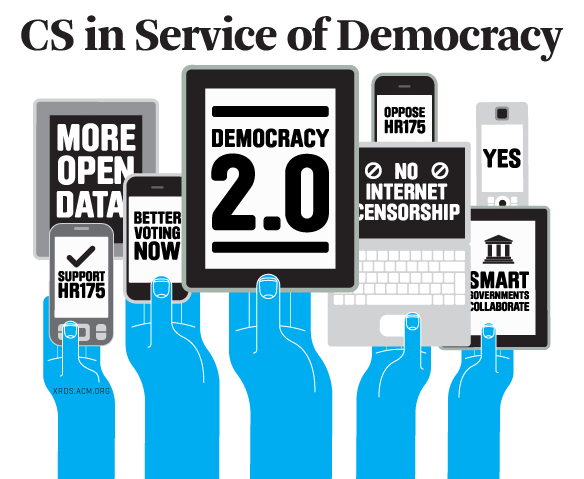
Since the passing of the Freedom of Information of Act in 1966, open government has become a term bandied about by journalists, activists, and even the current President of the United States. However more than the declassification of state secrets, information access—spurred on by the World Wide Web—has opened the door for a global movement: open democracy. The combined efforts of politicians, programmers and everyday citizens are highlighted in the latest issue of XRDS. From censorship to crimemapping, we explore how computer science can strengthen democracy.
Download
- Digital Edition web-based magazine available for subscribers – sign in
- PDF via ACM’s Digital Library


SECTION: Features
Inventing open government
Internet startup POPVOX connects constituents to Congress in a play to disrupt the world of advocacy.
By Joshua Tauberer

Using software to liberate U.S. case law
Although public information is open, it is not always easily accessible.
By Harlan Yu, Stephen Schultze

FREE CONTENT FEATURE
An interview with Dr. Beth Simone Noveck
The former U.S. Deputy Chief Technology Officer and the author of Wiki Government: How Technology Can Make Government Better, Democracy Stronger and Citizens More Powerful discusses open government and what it really means.
By Peter Kinnaird

Shared values, clashing goals
The difference between aggregating public data and investigative journalism.
By Sarah Cohen

How can software engineers help make government better?
Using their technical expertise to bring transparency to the federal government, developers are unlocking data one API at a time.
By Luigi Montanez

Can data visualization help build democracy?
An overview of OECD's Better Life Index Experience.
By Jérôme Cukier


Recent ideas for circumventing internet filtering
Technical solutions can provide a skeleton key to unlocking the Internet.
By Dan Boneh

Fighting censorship with algorithms
By Mohammad Mahdian

Profile Cameron Wilson
ACM's man in Washington
By Robert J. Simmons


SPECIAL SECTION: Online Features
FREE CONTENT FEATURE
Smarter Cities: Making societies smarter
In this article we outline the technological characteristics and features of "smart cities," describe how these are being implemented in the real-world, and explore some of the challenges these characteristics present to communications technologies.
By Peter J. McNerney, Ning Zhang